
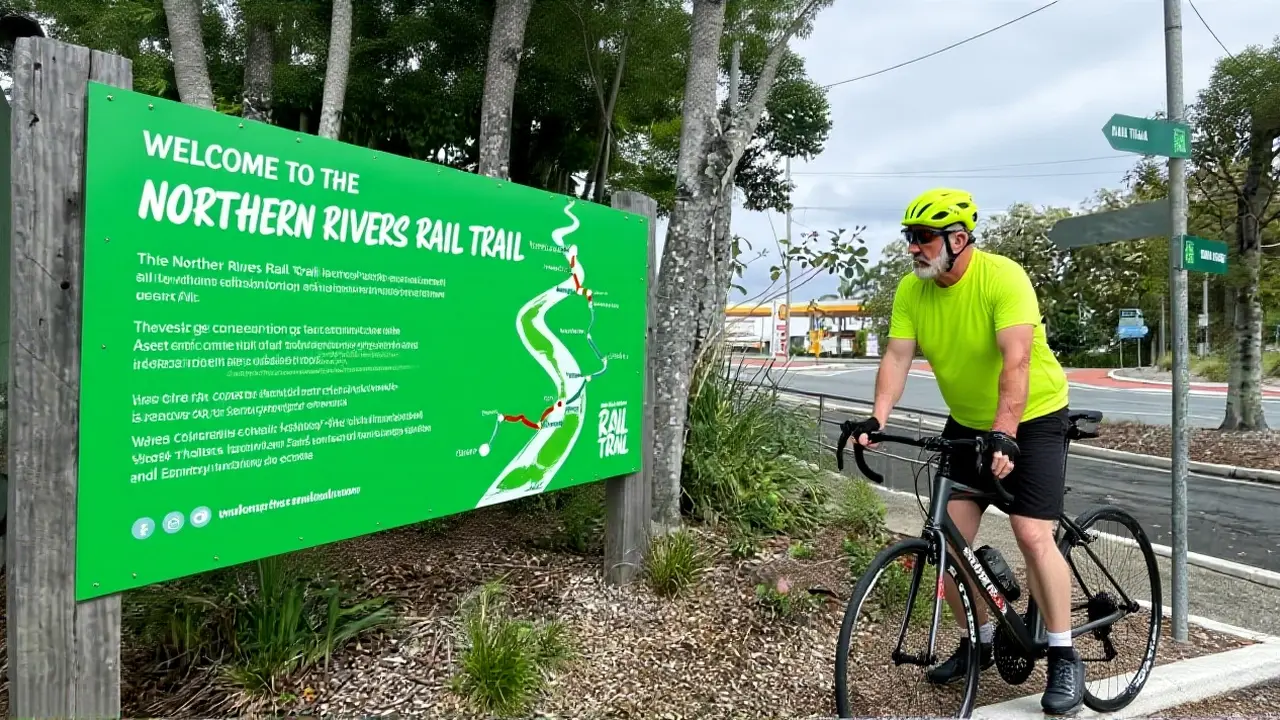
A community-led movement to finish the Northern Rivers Rail Trail Northern Rivers Region is rapidly picking up steam, with organizers aiming to force the government's hand through sheer numbers. The push focuses on securing the final funding needed to bridge a 74-kilometre gap that currently prevents the trail from becoming a seamless, 132-kilometre journey through one of Australia's most breathtaking landscapes. If successful, the project will finally link Crabbes Creek to Lismore, creating a massive draw for tourism and outdoor recreation.
Here's the thing: while the vision is grand, the funding hasn't fully materialized yet. That's where the petition comes in. Led by Pat Grier, President of Northern Rivers Rail Trail Supporters, the campaign has already gathered over 2,000 signatures. But Grier isn't looking for a modest win. He's eyeing a target that would make any politician stop and listen.
- Current Gap: 74 kilometres still need completion.
- Total Proposed Length: 132 kilometres of continuous trail.
- Petition Target: Official goal of 100,000 signatures (Grier personally aims for 200,000).
- Key Connection: Linking Crabbes Creek to Lismore.
- Local Support: Byron Shire Council has officially approved its 54km section.
The Battle for the Byron Section
The heart of the current struggle lies in the "Byron section." It's the missing piece of the puzzle. Interestingly, the Byron Shire Council has already stepped up, with councillors voting in favor of the major project and officially approving the 54-kilometre stretch within its borders. This local victory provides a critical foundation, but the project still needs a significant injection of state and federal cash to cross the finish line.
Grier's ambition is palpable. When discussing the initial 2,000 signatures, he didn't just express satisfaction—he set a staggering new benchmark. "I'm aiming for 100 times that," he remarked, signaling a personal target of 200,000 signatures. While the official campaign goal is set at a more conservative 100,000, the message to the government is clear: there is an overwhelming public appetite for this trail.
Why Rail Trails are Winning Globally
The Northern Rivers project isn't an isolated dream; it's part of a global trend of converting dead rail lines into "green corridors." Turns out, people everywhere are craving these accessible, scenic routes. For example, over in New York, the Niagara Falls National Heritage Area is currently drafting a Master Plan for 13 miles of the old Somerset Rail Line. Similarly, in Charlotte, North Carolina, a massive Rail Trail Bridge project recently celebrated its kickoff, connecting Uptown Charlotte to SouthEnd with backing from heavyweights like U.S. Bank and the North Carolina Department of Transportation.
These projects do more than just provide a place to bike. They breathe life into regional economies by bringing in "slow tourism"—visitors who spend money at local cafes, B&Bs, and shops along the route. For the Northern Rivers, completing the link to Lismore would likely trigger a similar economic ripple effect, transforming a fragmented path into a premier national destination.
The Complexity of 'Railbanking'
But wait, it's not as simple as just paving over old tracks. The process, known as railbanking, is a regulatory minefield. In many jurisdictions, groups must file a Notice of Interim Trail Use (NITU) within a tight 20-day window after a railroad abandonment is published in official registries. In the U.S., for instance, the Surface Transportation Board manages these through regulated or exempt abandonments.
Australia's process is similarly complex, involving land rights, environmental assessments, and multi-level government agreements. The reason the Northern Rivers Rail Trail Supporters are pushing so hard for a massive petition is that these regulatory hurdles are often only cleared when there is an undeniable, high-volume public demand that makes the project politically impossible to ignore.
What Happens Next?
The next few months will be critical. As the petition grows, the Supporters group plans to present the findings to state and federal representatives. The goal is to move the project from the "proposed" column to the "funded" column in the next budget cycle. If they hit that 100,000-signature mark, they'll have a powerful piece of leverage to demand the final funding for the 74-kilometre gap.
Oddly enough, the success of this trail could set a precedent for other abandoned lines across the country. If the Northern Rivers model works—combining local council approval with a massive grassroots mandate—it could spark a gold rush of rail-to-trail conversions across Australia's rural heartlands.
Frequently Asked Questions
How long will the finished Northern Rivers Rail Trail be?
Once the remaining 74 kilometres are completed, the full trail will span a continuous 132 kilometres. It will create a seamless link between Crabbes Creek and Lismore, cutting through some of the most scenic parts of the Northern Rivers region.
What is the goal of the current petition?
The official goal is to collect 100,000 signatures to demonstrate overwhelming community support. These signatures will be presented to state and federal governments to secure the final funding required to complete the missing sections of the trail.
Has the Byron Shire Council supported the project?
Yes, the Byron Shire Council has recently reaffirmed its support. Councillors officially voted in favor of the project, approving the 54-kilometre section that falls within the shire's jurisdiction.
What is 'railbanking' and why does it matter?
Railbanking is the legal process of preserving a railroad corridor for future use, often by converting it into a public trail. It involves strict regulatory timelines and filings to prevent the land from being sold off in fragments, which would make building a continuous trail impossible.
Who is leading the campaign for the trail?
The campaign is being led by Pat Grier, who serves as the president of the Northern Rivers Rail Trail Supporters. Grier is the primary driver behind the petition and the strategy to engage state and federal funding bodies.
nikolai kingsley
April 18, 2026 AT 11:45absolute joke that the govt is draggin their feet on this while other regions get all the cash its basic human right to have access to nature and this is just plain wrong totaly pathetic logic from the state
Gary Clement
April 18, 2026 AT 19:56railbanking is such a game changer for urban planning especially when you consider the adaptive reuse of existing infrastructure to minimize environmental impact
Dianna Knight
April 20, 2026 AT 02:34This is such a vibe! ✨ We need to lean into these sustainable modalities to optimize the local ecosystem and boost the socioeconomic KPIs for the region. Total win-win for the community! 🌈💖
Antony Bachtiar
April 20, 2026 AT 03:11100k signatures is a joke. Who even has time for this? Its just gonna be another waste of tax payer money that doesnt solve any real problems lol
Mason Interactive
April 20, 2026 AT 09:02Actually reminds me of some trails we have in the States. It's a great way to get people out of their cars and into the scenery.
Mel Alm
April 22, 2026 AT 00:47i agree with the trail idea but lets keep it respectful to the land owners too
Beth Elwood
April 22, 2026 AT 07:59The economic impact of slow tourism is massive 🚲. Local B&Bs and cafes will see a huge spike in revenue once that gap is closed. It's a proven model in Europe and North America! 📈🌟
Aaron X
April 23, 2026 AT 11:22The ontological shift from industrial utility to recreational leisure represents a fascinating teleological evolution of the landscape. We are essentially witnessing the commodification of nostalgia through the lens of environmental stewardship. This spatial reconfiguration challenges the traditional hegemony of automotive transit by imposing a decelerated tempo on the human experience. By leveraging the railbanking mechanism, the community is not merely reclaiming land but is engaging in a dialectic between the ghosts of the industrial revolution and the aspirations of a post-carbon society. The systemic inertia of the bureaucracy is the only remaining obstacle to this synthesis. It is a quintessential example of the tension between grassroots agency and state-level administrative rigidity. The petition is not just a list of names but a manifesto for a different way of inhabiting the geography. To ignore such a mandate would be to deny the very essence of democratic participation in urban planning. The synergy between local governance and public will is the catalyst for this metamorphosis. Ultimately, the trail becomes a conduit for both physical travel and metaphysical reflection on our relationship with nature. Such projects are the architectural embodiment of a societal desire for reconnection. The logistical complexity of the NITU process is a triviality compared to the existential value of the resulting green corridor. This is the path toward a more integrated regional identity.
Josh Raine
April 23, 2026 AT 17:12Why is it always the government that blocks progress? It's honestly exhausting watching these projects get stuck in red tape while the world burns :)
Alex Green international
April 24, 2026 AT 21:03I believe that the collective effort of the community will eventually prevail over the bureaucratic obstacles presented by the state authorities