
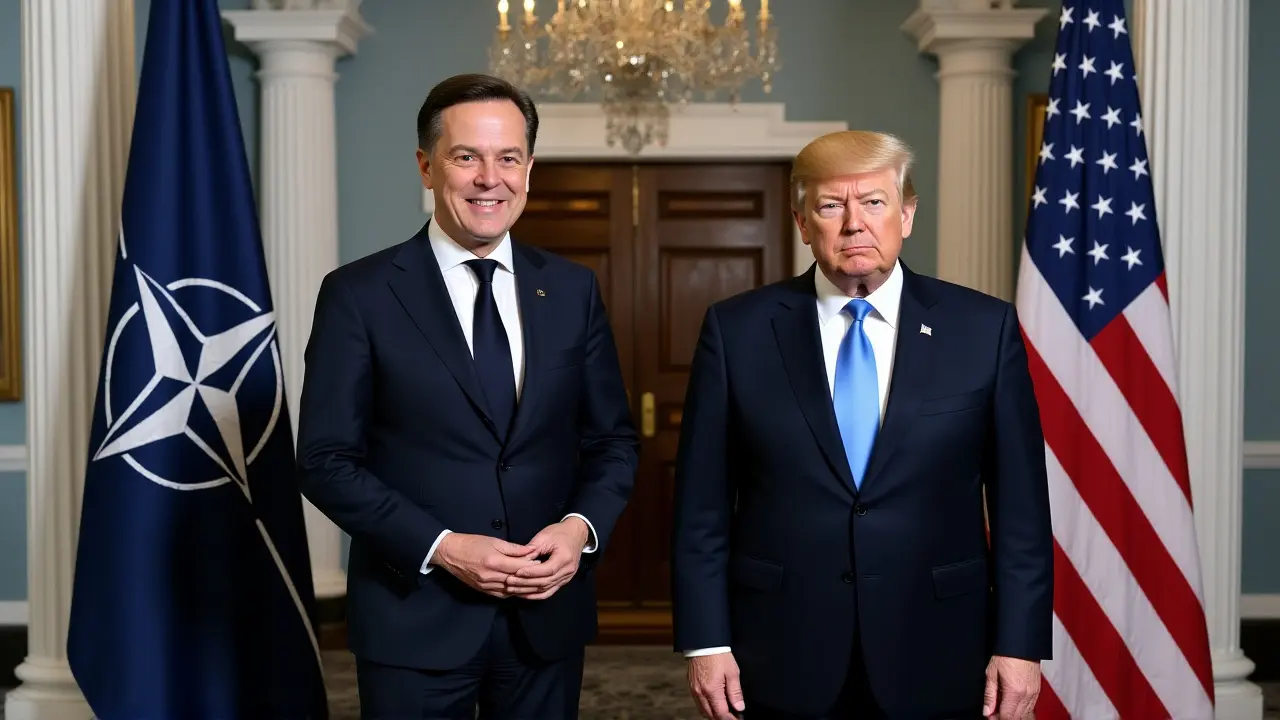
Donald Trump has sent shockwaves through the transatlantic community after a closed-door meeting with Mark Rutte, the Secretary-General of NATO, on Wednesday, April 9, 2026. The meeting was intended to soothe the president's growing fury over the alliance's refusal to back U.S. military operations during the conflict with Iran, but it seemingly backfired. While a fragile two-week ceasefire with Tehran was signed just 24 hours earlier, the president isn't letting his allies off the hook for what he views as a betrayal during the heat of battle.
Here's the thing: this isn't just about a few disagreements over strategy. It's a fundamental clash over the cost of security. The tension peaked just as the Strait of Hormuz—the world's most critical oil artery—finally reopened after being shut down by Iran, a move that had sent gas prices skyrocketing for American families. For Trump, the reopening of the waterway is a win, but the lack of European muscle during the fight is a scar he isn't willing to ignore.
- The Conflict: U.S. military efforts in Iran saw limited support from key NATO partners.
- The Breaking Point: Spain and France restricted U.S. access to airspace and bases.
- The Legal Hurdle: A 2023 Congressional law requires legislative approval for any NATO withdrawal.
- The Current State: A two-week ceasefire between the U.S. and Iran began April 8, 2026.
The Breaking Point: "Cowards" and Closed Airspace
The friction isn't coming from nowhere. During the recent hostilities with Iran, the U.S. found itself surprisingly isolated. Spain and France—two pillars of the alliance—essentially locked their doors, forbidding or severely restricting the use of their airspace and joint military facilities for U.S. operations. To the president, this wasn't just a diplomatic disagreement; it was a lack of loyalty.
Trump didn't mince words, branding his partners as "cowards" for failing to lead the effort to open the Strait of Hormuz. But wait, there's more. The president also brought up his old obsession: Greenland. Despite previously backing off after talks with Rutte, Trump took to social media on Wednesday to blast the territory as a "BIG, POORLY RUN, PIECE OF ICE!!!" It's an odd pivot, but it highlights a president who feels the current global order doesn't serve American interests.
A Unified Front in the White House
Interestingly, the rhetoric isn't just coming from the Oval Office. Traditionally, the State Department acts as a stabilizer, but this time, the leadership is in lockstep with the president. Marco Rubio, the Secretary of State, told Fox News on March 31 that the U.S. must "reevaluate" its role in the alliance. When he says "everything's on the table," he means it. This sentiment was echoed almost verbatim by NATO Ambassador Matt Whitaker on April 1 during an appearance on Newsmax.
White House Press Secretary Karoline Leavitt added a layer of financial grievance during Wednesday's briefing. She pointed out that it's "quite sad" that NATO turned its back on the U.S. over the last six weeks, especially since American taxpayers have been the primary funders of European defense. This "pay-to-play" mentality is a recurring theme in Trump's foreign policy, treating a military alliance more like a subscription service than a mutual defense pact.
The Legal Tug-of-War Over Withdrawal
Can the president actually walk away? It's not that simple. In 2023, Congress stepped in to prevent a unilateral exit by passing a law that forbids any president from pulling out of NATO without explicit congressional approval. It was a preemptive strike designed specifically to keep the U.S. anchored in the alliance regardless of who sits in the White House.
However, while a total exit might be legally blocked, Trump still has other tools in his kit. Reports suggest he is considering a more surgical punishment: pulling U.S. troops out of specific countries that refused to help in the Iran war. That would create a security vacuum in those specific regions without officially triggering a full alliance collapse.
Rutte's Mission to Save the Alliance
Secretary-General Mark Rutte arrived in Washington with a heavy lift. He spent his visit trying to bridge the gap, meeting with both Trump and Rubio to discuss more than just Iran. The talks touched upon Operation Epic Fury Washington, D.C. , the U.S.-led effort to negotiate an end to the Russia-Ukraine war. Rutte is banking on the success of last year's summit in The Hague, where allies finally agreed to ramp up their defense spending to meet Trump's demands.
Turns out, spending more money might not be enough this time. The grievance here isn't about the budget—it's about blood and boots on the ground. Rutte is attempting to pivot the conversation back to collective security and burden-sharing, but the president's all-caps social media blast after the meeting suggests that the olive branch didn't take. "NATO WASN'T THERE WHEN WE NEEDED THEM," Trump wrote, leaving the world to wonder if the 77-year-old alliance is facing its most existential crisis yet.
Frequently Asked Questions
Why is President Trump angry with NATO specifically?
The president is furious that NATO allies, specifically France and Spain, restricted U.S. military access to their airspace and bases during the conflict with Iran. He believes these countries acted as "cowards" by refusing to support U.S. efforts to secure the Strait of Hormuz, despite the U.S. providing significant funding for their own defense.
Can Donald Trump legally leave NATO?
While he has threatened to do so, a 2023 law passed by Congress prevents any U.S. president from unilaterally withdrawing from the alliance. Any formal exit would require the approval of Congress, making a sudden departure legally difficult despite the president's rhetoric.
What is Operation Epic Fury?
Operation Epic Fury is a current U.S.-led initiative aimed at bringing a negotiated end to the war between Russia and Ukraine. Mark Rutte and the Trump administration discussed this operation as part of a broader effort to coordinate security dynamics and shift more responsibility onto NATO allies.
How did the Iran ceasefire impact these tensions?
The ceasefire, signed on April 8, 2026, led to the reopening of the Strait of Hormuz, which helped stabilize global gas prices. While this ended the immediate military crisis, it actually highlighted the rift, as Trump felt the U.S. achieved the result without the help of its NATO partners.
What role does Greenland play in this dispute?
Trump has a long-standing interest in acquiring or controlling Greenland, a semi-autonomous territory of Denmark (a NATO member). He used the current tension to revive his criticism of how the "piece of ice" is run, using it as a psychological lever against the alliance's leadership.
Gary Clement
April 10, 2026 AT 21:38looks like the classic security dilemma playing out in real time. the us provides the umbrella and then gets mad when the people under it dont want to get wet too
Antony Bachtiar
April 11, 2026 AT 08:06imagine thinkin a 2023 law can stop a guy who just ignores everythin he doesnt like lol. congress has zero power when the executive decides to just stop payin the bills
Kartik Shetty
April 12, 2026 AT 13:01the preoccupation with Greenland is a transparent diversionary tactic to mask the deeper systemic failure of the neoliberal security architecture. it is simply quaint how the masses perceive this as erratic behavior rather than a crude exercise in leverage
Josh Raine
April 13, 2026 AT 13:10Who the hell are we to judge France and Spain for protecting their own airspace during a conflict they didn't start? 🙄 The hypocrisy of demanding total loyalty while treating the alliance like a freaking gym membership is insane. We're just seeing the death throes of the Pax Americana and it's honestly pathetic to watch the ego drive the steering wheel here. Give me a break!
nikolai kingsley
April 14, 2026 AT 05:47honestly just embarassing that we even pretend to have allies anymore. spain and france are just acting like the rest of the world now by puting there own interests first. its moraly bankrupt to expect a free ride and then complain when the driver wants a tip
Beth Elwood
April 15, 2026 AT 00:08Actually, from a logistics standpoint, the Strait of Hormuz is a single point of failure for global energy markets ⛽. If the US is the only one with the guts to keep it open, it makes total sense why they'd be ticked off about the lack of support 📉
Shelley Brinkley
April 16, 2026 AT 16:24lool a 2 week ceasefire is basically a nap. he's just gonna wake up and start yelling again tomorrow anyway. nato is a joke lol
Aaron X
April 17, 2026 AT 16:36The geopolitical paradigm is shifting toward a transactional realism where the traditional ontological commitments of collective defense are superseded by immediate strategic utility. We are witnessing the erosion of the Westphalian consensus in favor of a neo-mercantilist approach to security sovereignty
Dianna Knight
April 19, 2026 AT 14:15It's such a stressful time for everyone involved! 🌸 Maybe if we focused more on the diplomatic synergies of Operation Epic Fury, we could find a way to maintain the equilibrium without all the shouting. Let's hope for some actual collaboration soon! ✨
Mason Interactive
April 20, 2026 AT 18:15Man, the Greenland thing always kills me. Like, imagine waking up and deciding you want to buy a giant island because you're mad at some guys in Brussels. Peak chaos energy
Mel Alm
April 20, 2026 AT 19:18its just weird to call them cowards when they probably just didnt want there cities blowen up in a war that isnt theirs
Alex Green international
April 21, 2026 AT 15:53I believe it is important to recognize the immense pressure the administration is under to ensure economic stability for the average citizen. The reopening of the Strait of Hormuz was a necessary step for the American people
sachin sharma
April 22, 2026 AT 00:16Just watching it all unfold from a distance. It feels like a movie script at this point
Ashish Gupta
April 23, 2026 AT 17:58Keep pushing for a better deal! 🚀 The US has too much power to just be ignored by Europe. Time for them to step up or step aside! 💪🔥
Pranav nair
April 25, 2026 AT 01:54I feel for Rutte, he's basically trying to put out a forest fire with a water pistol :)
Suraj Narayan
April 25, 2026 AT 13:44Exactly! Europe has been lazy for decades. If you want a security guarantee, you pay the price. Simple as that. Stop the whining and start the spending!
Dr. Sanjay Kumar
April 26, 2026 AT 04:24Absolute madness! A total circus! We're talking about the most powerful alliance in history and it's being treated like a dispute over a parking spot! Unbelievable!
Anamika Goyal
April 27, 2026 AT 11:56I wonder if the 2023 law actually holds any weight if the president simply refuses to authorize the funds for the troops stationed abroad. If he pulls troops from France or Spain as a penalty, he isn't technically leaving NATO, he's just changing the deployment. That seems like a much more likely path than a full legal battle with Congress which would take way too long and potentially trigger a market crash if the world thinks the US is totally isolating itself. Plus, it puts the pressure back on the Europeans to either make a deal or figure out how to defend themselves without the US Army in their backyard which they definitely aren't ready for yet given their current budgets